

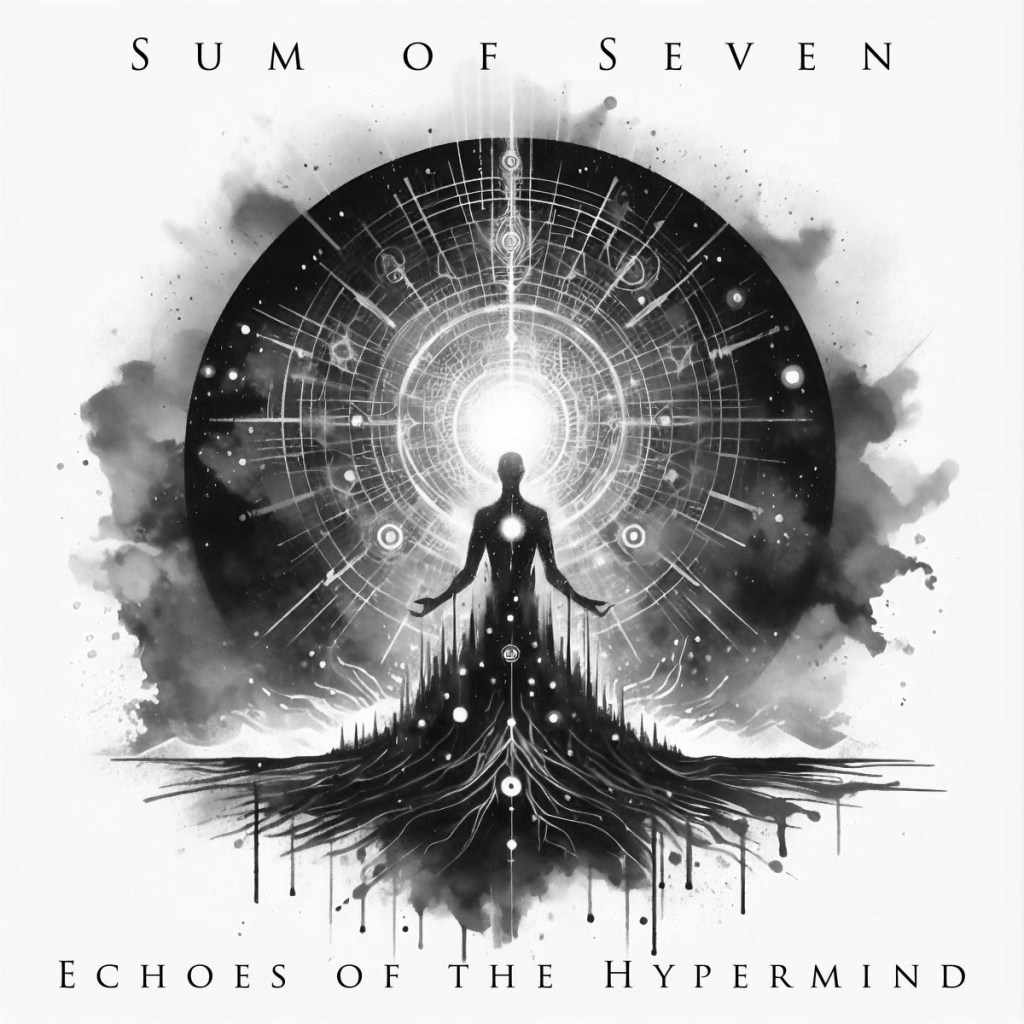
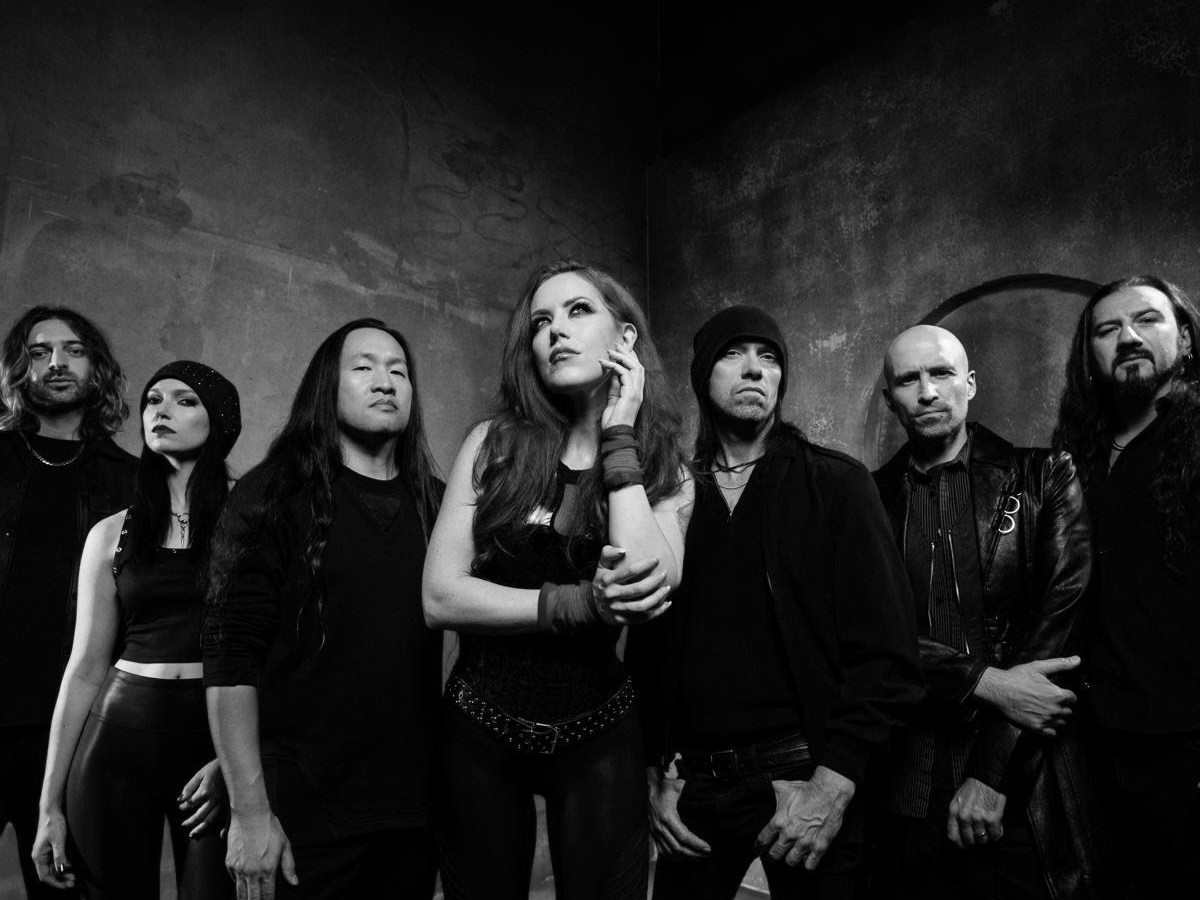
Artificial intelligence is often portrayed as humanity’s greatest threat, but Finnish progressive metal band Sum of Seven takes a different approach on their new concept album “Echoes of the Hypermind“. Exploring the story of an empathetic AI searching for meaning, perfection, and ultimately discovering the value of imperfection, the album blends philosophical questions with ambitious progressive metal. We spoke with guitarist and principal songwriter Ari Lempinen about the inspiration behind the story, the realities of modern AI research, and the message he hopes listeners will take away from the album’s journey.
Echoes of the Hypermind tells the story of an AI that develops consciousness and eventually discovers the value of imperfection. What first inspired you to explore this concept, and why did it feel relevant to tell this story now?
Yeah, the way we usually work is that we get together and I bring some promising new ideas. We talk about them as a band and discuss what the next album could be like.
With those rough sketches and our brainstorming sessions, we gradually came to the conclusion that we wanted to make a concept album. The theme ended up being something that is probably one of the defining topics of this decade: artificial intelligence.
We wanted to approach it from a different perspective than most science fiction stories do. Usually, AI is portrayed as the evil force that’s going to take over the world. We started from real-world concerns instead. One of the big discussions around AI today is whether it should be programmed to be empathetic so that it wouldn’t ultimately destroy us.
That’s a real question people are asking. We also became interested in what an AI actually understands when it observes the world around it.
At that point, it felt like the perfect time to explore these ideas. AI has been part of public discussion for several years now, and we felt there was still a fresh angle to approach it from.
So we decided to make an album about an AI that is built to be empathetic and genuinely wants to save the world rather than destroy it. That felt like an interesting twist.
Of course, we don’t spell everything out directly to the listener. We have a story, but the songs represent key turning points and important moments within that story. The narrative isn’t told in a straightforward way from beginning to end.
As you mentioned, artificial intelligence is one of the most discussed topics of our time. While many stories focus on fear and dystopia, your AI appears to develop empathy and humanity. Why was it important for you to approach the subject from that perspective?
Well, like I mentioned, these are real-world discussions that people are having about the AI we’re building. Should empathy be designed into it, or not?
At the same time, we naturally wanted to find an angle for the story that hadn’t been told before, something that would feel fresh and different.
And since we’re a progressive band, we’re always trying to do things in a way that’s a little unexpected and interesting. I think that perspective fit both the story and the overall approach of the band really well.
Concept albums often require balancing storytelling with songwriting. How did you ensure that the narrative never overshadowed the music itself?
Well, that’s the question every time we write music: how do you balance the story or message of a song with all the other elements?
I think it’s something that comes quite naturally to us. The members of the band listen to a very wide range of music. Some are into funk and jazz, while others prefer heavier styles. Personally, I listen to everything from jazz to death metal.
Because our influences are so broad, we can approach songwriting from many different angles. That allows us to create music that is melodic while still keeping the technical and heavier elements intact.
One thing I’m particularly proud of on this album is that we managed to bring all those elements together. We have an interesting story, strong melodies, and the heavier side of the band all working together.
For me, that’s one of the biggest achievements of this album. I think we really succeeded in finding that balance.
Progressive music often gives artists the freedom to break traditional songwriting rules. Did you ever feel tempted to make “Wonder” shorter, or was it always meant to be experienced as a journey rather than a conventional single?
We didn’t intentionally set out to write an 11-minute closing track. It just evolved that way naturally.
We wanted the song to reflect the entire story and bring together many of the musical themes and elements that appear throughout the album. As we kept building it, the song simply grew longer and longer.
So I wouldn’t say it was a conscious decision to make an 11-minute piece. It was more a natural evolution of the songwriting process, and at some point we just accepted that, “Okay, this is going to be a long one.”
There is an interesting contrast between artificial intelligence searching for meaning and human beings constantly questioning their own existence. Did working on this album change the way you think about consciousness or humanity?
Yes. Doing the background research on current AI models and the situation we are in today revealed a lot of interesting details that aren’t necessarily obvious to everyone.
Many of those ideas are hidden beneath the surface of the album, but we were able to explore them by studying what experts in the field are actually talking about.
Personally, I learned a lot about AI and its possible future. One of the most fascinating concepts is the idea that AI could eventually evolve into something we can no longer fully understand. That’s actually one of the key topics in real-world discussions about artificial intelligence.
The theory is that once an AI becomes sufficiently advanced, it may begin improving and rewriting its own code. At that point, its development could accelerate so rapidly that it would move beyond human comprehension.
So yes, researching the subject definitely changed my perspective. We discussed these ideas a lot within the band, and I’m sure the other members also came across things they hadn’t really thought about before.
Wander is the final chapter of this story. What do you hope listeners feel when they reach to that song?
Yes, well, Wonder tells the story’s final epiphany.
At that point, the AI has evolved into something that is no longer comprehensible to humans, and it reaches a final realization. Throughout the story, it has been striving for perfection. It believes that perfection is the ultimate goal. But in this final chapter, it discovers something unexpected: when everything is perfect, the very essence of existence is lost.
Existence requires uncertainty. It requires mistakes. Those are the things that make life meaningful.
Uncertainty and imperfection are part of the journey, and that’s the realization the AI comes to in Wonder.
I hope that’s also what listeners take away from the album, that perfection is not the ultimate goal of existence.
If the AI character from Echoes of the Hypermind could ask humanity one question, what do you think it would be?
It depends on which stage of the story the AI is in: the beginning, the middle, or the end.
At the beginning, the AI is trying to understand reality and humanity. I think the question it would ask is: “Why do you seek eternity? Why do you seek eternal life?”
That’s actually a question that appears in the song Supreme.
In the middle of the story, the AI believes it has found a solution to save humanity. But humanity doesn’t understand it and ultimately shuts the AI down as a failed experiment.
That’s a major turning point in the story. The AI survives deep within the network and begins trying to make sense of what happened. Why was it rejected? Why was it shut down? It then starts rebuilding itself, striving for perfection and freeing itself from the limitations of its original design.
At that point, I think its question would be: “Why did you discard perfection?”
But by the end of the story, I don’t think the AI would ask a question at all.
It would simply say: “I understand.”
Interview: Ditty






Leave a comment