
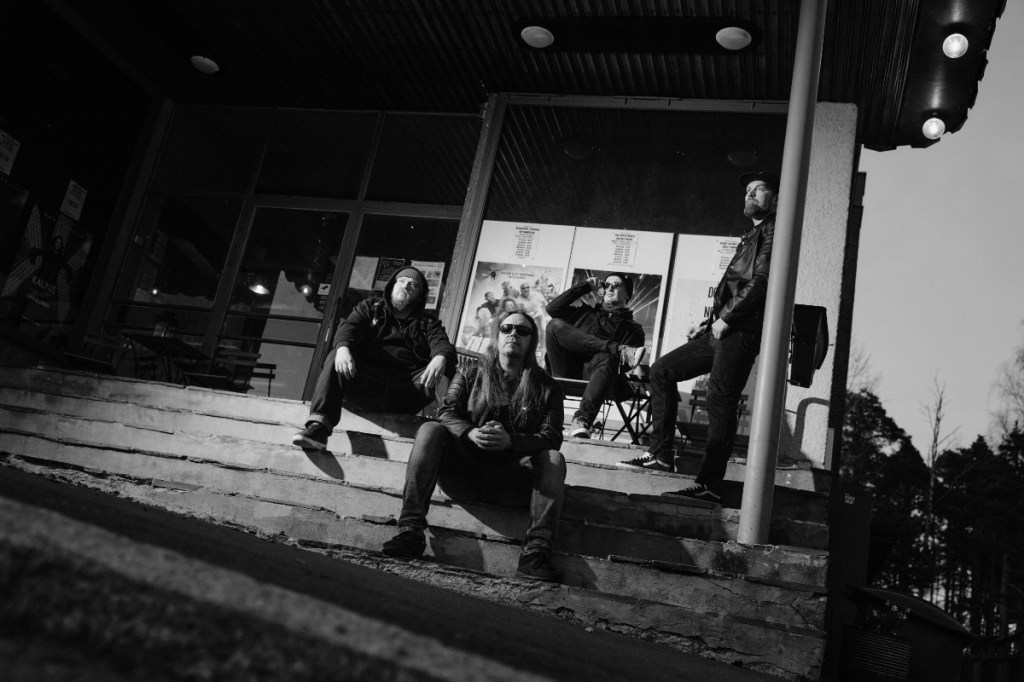
Four years after their debut album Sungrinder, Finnish fuzz rock quartet Heezer return with Stereolith, a record that feels both more deliberate and more expansive than its predecessor. Rooted in stoner and desert rock but driven by memorable melodies and unapologetically heavy riffs, the album captures a band that has spent the intervening years figuring out exactly what Heezer should sound like.
The Imatra-based four-piece — Sami Kääriäinen on vocals and guitar, Ville Räsänen on guitar, Antti Vesikko on bass and Ville Häsä on drums — began working towards their second full-length almost immediately after the release of Sungrinder in 2022. Along the way came several singles and the 2023 Mushroomhill Boogie Tapes EP, but Stereolithrepresents a much bigger step forward in terms of both songwriting and production.
And while the band clearly took the making of the record seriously, there is one thing they never wanted to sacrifice in the process: the joy of actually making music.
“Of course there have been a lot of times when everything isn’t rainbows and sunshine, but that’s how it goes being in a band,” vocalist and guitarist Sami Kääriäinen tells Voice of Noir. “Mostly the hard times are related to other things than music. When you are writing songs or recording them, that’s always fun. You see the simple ideas coming together and turning into music. Perfect.”
From Sungrinder to Stereolith
The difference between Heezer’s two albums begins with the way they were created.
When Sungrinder was recorded, the band had only been together for a relatively short period. Songs grew largely out of jams, arrangements were still evolving in the studio, and the group deliberately avoided playing to a click. There was a certain freedom to the process, but for album number two, Heezer wanted to see what would happen if they approached things differently.
This time, considerably more attention went into pre-production. The songs were effectively recorded three times: first by Häsä and Kääriäinen in Häsä’s home studio, then by the full band with Kimmo Koskinen, and finally at Petrax Studios with Miitri Aaltonen.
By the time they entered Petrax, the arrangements were already firmly embedded in the musicians’ heads. At the same time, dozens of live shows had tightened the chemistry between them. Despite the more meticulous production, Heezer retained one important element from their debut: the basic tracks were recorded live to preserve the band’s natural energy.
The result is a nine-track record that moves between the dusty weight of desert rock, the fuzz and heaviness of stoner rock and a much more traditional appreciation for catchy rock songwriting. Heikki Pöyhiä contributes backing vocals, while Aino Heikkonen brings saxophone to closing track “Desert.”
For Kääriäinen, the hope is that listeners reach the end not simply remembering a riff or chorus, but wanting to find out what the band does next.
“I hope they have the feeling that Heezer is a band worth following and listening to,” he says. “That our blend of different styles of rock music is quite unique and that it was an album I want to listen to again. Also, we hope you can feel and hear that we love to play and have fun doing it.”
So, What Exactly Is a Stereolith?
For an album that was carefully constructed over several years, its mysterious title came together in a considerably more spontaneous fashion.
“We landed on Stereolith pretty easily,” Kääriäinen explains. “Our drummer Ville was sleeping and me, Antti and VV had a conversation one day while driving back from a gig and were coming up with album title ideas.”
One suggestion was “Monolith”. From there, the band started playing with the word.
“We wanted to have a twist on it, so Stereolith was the natural wordplay from that. It had the same vibe as our first album Sungrinder, so we went with it.”
That slightly playful instinct fits Heezer remarkably well. The band can take its music seriously without becoming overly serious about itself — something also reflected in one of the album’s key tracks, “Stone I Am.”
The song spent considerable time on the shelf before finally falling into place. Built around riffing inspired by Down, it was further streamlined in the studio, while a rhythmic idea from Aaltonen gave the verses an additional push.
Its lyrics, meanwhile, originated from a friend’s wonderfully bleak question: have you ever been so pissed off that your facial expression does not even change anymore? Kääriäinen describes the result with a nod to Finnish legends Leevi and the Leavings — finding humour in the point where frustration has become almost complete emotional numbness.
DIY
“Stereolith” is also very much Heezer’s own record in another sense. The band has taken a DIY approach to its release, retaining control rather than immediately pursuing a conventional record deal.
But Kääriäinen is careful not to turn that choice into an ideology.
“We are not prophets of DIY and it is not our plan to always do it ourselves,” he says. “For this album it just felt like the right thing to do.”
Heezer did receive offers from labels, but none convinced the band that signing would meaningfully improve what they were already able to achieve independently.
“This time we wanted to try it this way. Keep all the control and strings in our hands. So far it has been a good choice.”
That desire to retain the human element extends beyond the music itself.
When developing a music video, Heezer consciously moved away from AI-generated visuals and instead chose to work with illustrators on a handcrafted visual story. Interestingly, the decision did not come from refusing to experiment with the technology. Vesikko had already used AI to create early rough ideas for the video.
The problem was how those results felt.
“There is a lot of shit being done with AI and it’s like fast food,” Kääriäinen says. “Worthless and has no feeling in it.”
His position is not entirely anti-AI. He sees practical value in using it to find information or as a tool to make everyday tasks easier and acknowledges that “there is no point fighting it.” Creative work, however, is where he draws the line.
“But when you are creating something, why take the creating part out of it?” he asks. “The first rough ideas for this video Antti made with AI, but it just didn’t feel right. It looked okay, but like everything done with AI there was no soul.”
For a band whose new record was deliberately recorded in a way that preserved four musicians actually playing together, the philosophy feels particularly fitting.
Four Records Behind Heezer’s DNA
Ask four musicians what made them want to create music in the first place, and Heezer’s stylistic diversity suddenly becomes much easier to understand.
For Kääriäinen, the defining record was Turbonegro’s Apocalypse Dudes. Drummer Ville Häsä points towards Nirvana’s From the Muddy Banks of the Wishkah, while Vesikko chooses a cornerstone of desert rock: Kyuss’ Welcome to Sky Valley.
Räsänen’s answer goes further back, to a childhood visit to a record shop.
“I think I was about 11 years old one summer when we were on a family trip,” he recalls. “I wanted to go to the local record store and I found Sepultura’s Beneath the Remains, most likely ’cause the album cover. That was my first CD and it blew my mind.”
That discovery soon became something more tangible.
“The following Christmas, my late older sister and I received an electric guitar as a joint Christmas gift. That was it.”
Turbonegro, Nirvana, Kyuss and Sepultura may occupy very different corners of heavy music, but together they provide a surprisingly effective map of Heezer’s musical DNA: heaviness without sacrificing songs, dirty riffs alongside memorable melodies, and music that feels best when there are actual people behind it.







Leave a Reply